
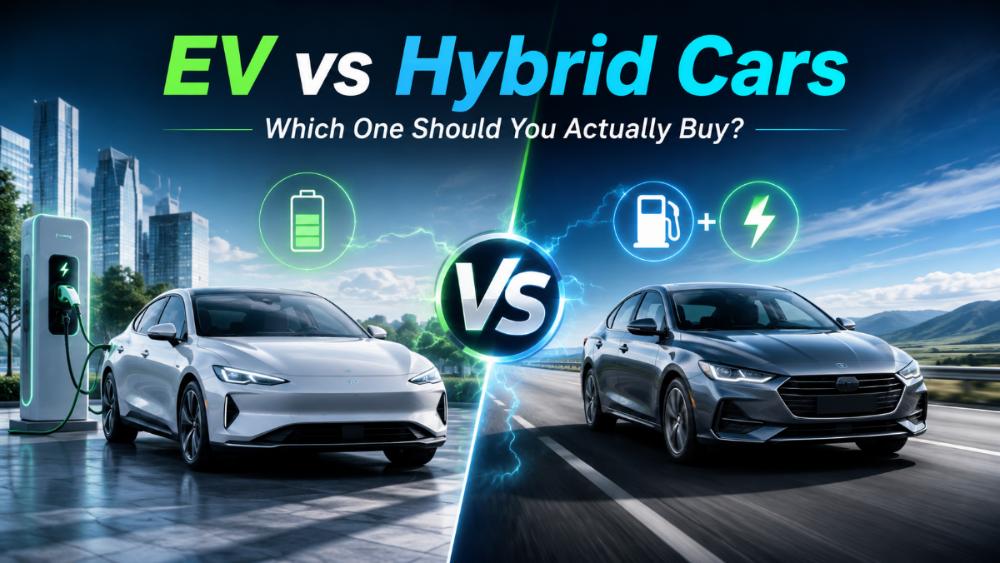
Well, you’ve finally decided to get rid of your old petrol car. Good choice! But now comes the tougher decision – should you opt for pure electric cars, or take the safer route and go for hybrids?
Believe me; you’re not the only one who feels perplexed in such a situation. I receive similar queries frequently from my family, friends, or first-time buyers as well as those drivers who are well-versed in this field but need a straightforward reply. Let’s cut the chase and provide a sincere guide to Electric Vehicles versus Hybrid Cars.
EV vs Hybrid Cars: What’s the Difference?
Before making the EV vs Hybrid Cars comparison, here’s what you need to know.
Battery Electric Vehicles (BEVs) – such as the Tesla Model Y or the Hyundai Ioniq 6 – operate purely using electric energy. No petrol, no exhaust pipe, no fuel station stops. You plug in at home overnight and you’re good to go the next morning.
There are two types of Hybrid Cars. The standard type (Toyota Camry Hybrid) has a petrol engine with an auxiliary electric motor. Its batteries charge themselves via regenerative braking – it never needs plugging. However, the capacity of the battery of Plug-in Hybrid Electric Vehicles (PHEVs) is much higher than the capacity of ICEVs and BEVs and the battery can be charged separately, giving you an electric range of about 20-65 miles of travel before engaging the petrol engine.
In other words, a hybrid is a backup system. An EV is going all-in on electric — which brings us to the real question in the EV vs Hybrid Cars debate: which one fits your lifestyle?”
EV vs Hybrid Pros and Cons: The Honest Breakdown
EVs – For Whom?
If you live and drive primarily in urban areas, can recharge at home, and your driving range does not exceed 200 miles per day, then a fully electric car would be absolutely wonderful for you. The electricity that you’ll spend on refueling is much cheaper per mile than gasoline – EVs could be up to 70% cheaper to run than traditional cars. Besides, EVs produce no emissions whatsoever, which is great if you do not want dirty air and if you have children traveling with you.
Maintenance of the vehicle? Very easy. There are no oil changes needed; there are no transmission components, nor exhaust system.
However, the problem with EVs is the initial cost – EVs are more expensive when compared to similar hybrid vehicles. In addition, if your travels take you far distances, and if charging the vehicle at home is not an option, then range anxiety becomes a major problem.
Best for: urban commuters, tech lovers, green families, professionals with routine daily commuting paths.
Going Hybrid – The Intelligent Choice?
This is what needs to be said: Hybrids have become very popular and there is an obvious reason for that – you get much improved fuel consumption compared to a standard petrol car, yet you do not need to alter the process of refueling. Fill up at any petrol station, just like you always have.
Plug-in hybrid electric vehicles (PHEVs) hit a particularly sweet spot for a lot of people. Short daily commutes? Cover them on electric alone. Weekend road trip? The petrol engine steps in without missing a beat. It’s genuinely the best of both worlds for drivers who aren’t ready to fully commit to electric.
The trade-off is that hybrids still produce emissions and you’re still tied to petrol prices. And the downside is that hybrids still pollute and you’re still dependent on gas prices. While the initial purchase price is cheaper, fuel savings over time won’t be quite as significant as an all-electric vehicle.
Best For: First-time converters, rural and semi-rural drivers, long-distance travellers, fleet operators, family cars needing flexibility but not needing infrastructure change.
Which Is Better for Long-Distance Driving?
Let’s be straightforward here – hybrids currently have the edge on long road trips. Most contemporary electric cars come with the capability to cover 300 to 400 miles on a single charge. However, despite being an impressive number on paper, quick charging can be done in more time compared to filling the tank with gasoline in just five minutes. In case of being a frequent highway driver or operating a company fleet that travels intercity highways, the convenience of filling up and driving off cannot be overlooked.
But then again, things are changing every year.
EV vs Hybrid Reliability: What You Should Know
Both are generally reliable, but EVs have a structural advantage – fewer mechanical components mean less that can go wrong. No timing belts, no oil filters, no exhaust systems. Lower maintenance bills are a real, consistent benefit over 5–7 years of ownership.
Models that have been around for a long time, such as the Toyota Prius (available since the late 90s), have proven their high reliability. The fact that plug-in hybrid electric vehicles (PHEVs) consist of two engines makes them a bit complicated; however, reliable models can be purchased nowadays.
Technology used for batteries in each type of vehicle has developed considerably. Modern batteries last at least 10-15 years in regular conditions. In addition, most manufacturers provide a warranty period of 8 years.
Cost Comparison: Should I Purchase a Hybrid Car?
| EV | PHEV | Hybrid | |
| Upfront Cost | Higher | Mid-range | Lower |
| Fuel Savings vs Petrol | Up to 70% | Depends on usage | Up to 60% |
| Tax Incentives | Often eligible | Often eligible | Usually none |
| Maintenance Cost | Lowest | Moderate | Moderate |
| Home Charging Needed | Yes | Optional | No |
| Long-Distance Convenience | Plan stops | Flexible | Seamless |
Run the numbers over five to seven years and EVs often come out ahead on total ownership costs – especially where government incentives are available. But if the upfront price is a stretch, a PHEV bridges the gap very effectively.
Who Should Choose What?
Here’s a quick guide based on your lifestyle:
You’re an urban commuter or city family → Go EV. Short, predictable trips, home charging overnight, zero fuel cost. It’s a natural fit.
You’re a first-time buyer or rural driver → A hybrid is your safest bet. No charging worries, lower purchase price, same refuelling habits.
You take long road trips regularly → PHEV gives you electric benefits daily and petrol peace of mind on the highway.
You manage a business fleet → Hybrids or PHEVs offer the most operational flexibility right now, with lower total running costs than pure petrol vehicles.
You’re environmentally motivated and have charging access → EV, without question. Zero local emissions and the lowest carbon footprint available.
Conclusion
The EV vs Hybrid Cars debate doesn’t have one universal answer – and that’s actually a good thing. It means there’s a smart choice available for almost every type of buyer, driving habit, and budget.
It all comes down to being honest about who you really are as a driver, where you’ll be charging your electric car, and what you can afford. Get those three things right and the decision usually becomes pretty clear.
Here at Gizmotechie, we want to help you sort out the hype and make better decisions when it comes to technology – especially the most important decision that most of us are facing this year: What car do I drive next? Watch for more car buying guides and comparisons to come.
Frequently Asked Questions (FAQs)
Q1. What is the difference between a hybrid and an EV?
A hybrid and an EV are different as an EV uses electricity as the fuel source and needs to be plugged into the socket in order to get power, while a hybrid uses gasoline engines as well as electric motors, and hence the batteries get charged during driving.
Q2. Should I buy a hybrid car for my city drives?
It is not a bad idea as a hybrid will fit you well for driving in the city; however, if you have an option to charge your car at home, an EV is a better choice as it will help you save on both gas and maintenance in the future.
Q3. Which car should I prefer while driving long distances – an EV or a hybrid?
Though there have been many developments in EVs recently, nowadays hybrids are more practical to drive long distances because you can refuel your car in just several minutes.
Q4. Which car will need more maintenance – an EV or a hybrid?
Not really, in general, EV needs less maintenance. There are fewer moving parts in EVs and therefore fewer things that may wear out, and you don’t need to change oil and service the exhaust system.
Q5. What is a PHEV and why is it a perfect solution between EV and a hybrid?
Plug-in Hybrid Electric Vehicle allows you to use your car only on the electric power and switch to gasoline powered mode whenever it is necessary. It is one of the best solutions for most drivers.
Q6. Where can I find the latest EV and hybrid buying guides?
Gizmotechie covers up-to-date EV buying guides, hybrid car buying guides, battery technology insights, and honest comparisons to help you drive smarter – whatever your budget or lifestyle.


